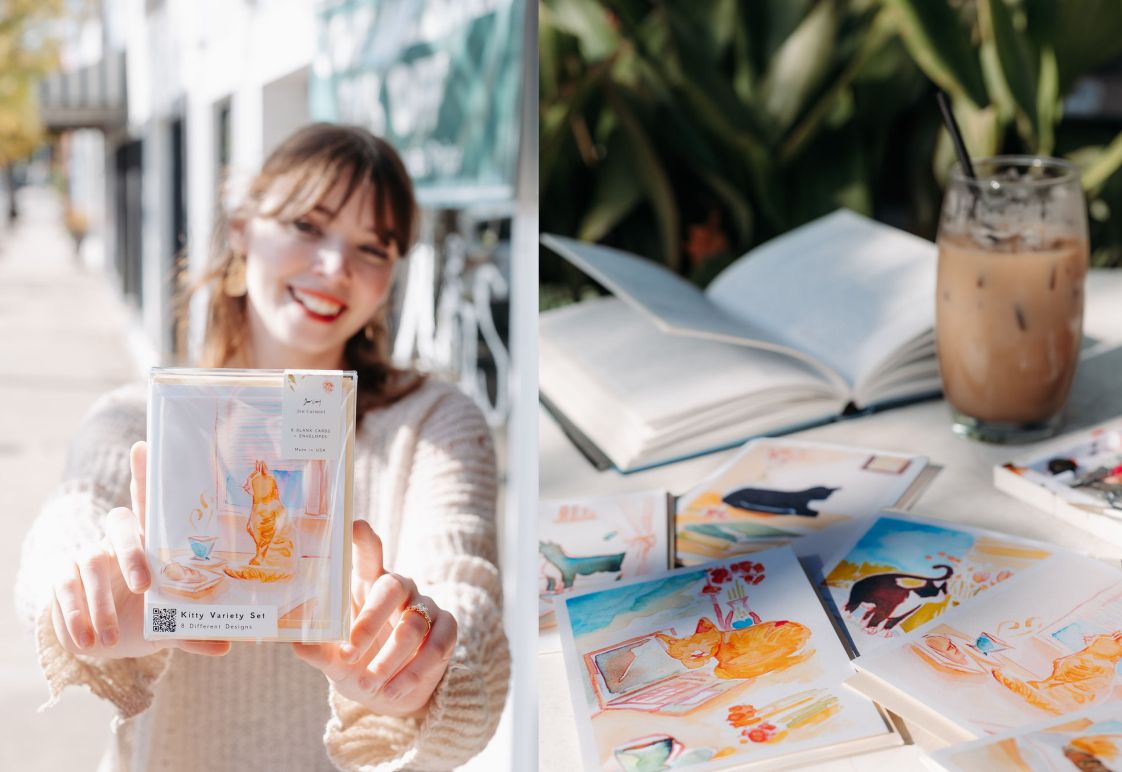

Jen Carmiel is a watercolor artist whose work celebrates small, everyday joys. Growing up in Florida, she began drawing as a child and started her professional artistic journey at just sixteen. After studying art at the University of South Florida, she built a career serving clients through watercolor paintings, prints, and greeting cards. She also writes a monthly letter celebrating the Small Joys for members of the Small Joys Club.
Like many creatives, Jen experienced a period of disconnection from her art while working a corporate 9–5. Reclaiming her creative life became a turning point. She left the traditional path, restructured her life, and returned to painting as a way of rediscovering meaning and joy.
Today, her warm, delicate watercolors invite us to slow down, notice the beauty of small moments, and remember that joy doesn’t have to be big — it’s found in the small things.
Read our conversation and discover where inspiration can quietly begin.

A conversation about small moments, courage, and coming back to oneself
1. Your work often celebrates small, quiet moments. Why do you think joy hides there?
Growing up, I knew many people who would brag about big accomplishments: all the different countries they travelled to, how much money they earned, what intellectual, deep topic they learned about that day. At the same time, I noticed they were the most miserable people I’d ever met.
It was like they were masquerading happiness, convincing everyone around them their life was the best– most happy, most fulfilling. I even tried achieving various things myself- but if this is happiness, I couldn’t see it. Why did it feel like there was never anything big enough, fulfilling enough, grand enough?
It was because the bar kept raising. It’s like you’re eying the horizon, always waiting for something– out there– to make you happy in here.
I realized that joy exists when we stop looking ahead, and instead look within. When you give up the chase. When you allow yourself to say “this is enough for me. I’m happy here.”
As 20th century painter Henri Matisse said: there are always flowers for those who want to see them.
2. You’ve spoken openly about losing your creative spark after art school. What was the hardest part of that period — and what helped you find your way back?
The hardest part of that period was how deceptively “okay” I was. Meaning, I was financially successful, others viewed me as someone who “had it together.” I could do almost anything I wanted, felt few restrictions… And yet I was so deeply unhappy. I didn’t necessarily feel sad but I felt no joy or drive for anything. Life was gray. There was no reason to get up in the morning– Every day, monotonous. Exactly the same.
The only thing that felt uniquely my own was my Saturday mornings spent at coffee shops. There, I would read a book, and feel like myself again. And once I left, it was like stepping foot back into the realm of “responsibilities.”
It turns out that I had engineered a life that was a great life, sure. But it was specifically someone else’s. I got the job, the salary. I got the life partner. Friends. I checked all the boxes– But who wrote this checklist?
It’s like cooking a recipe for a great seafood dish only to sit down at the table, taste it, and realize you hate fish.
The day I realized I wasn’t living my own life was when I got a painting commission request from a girl I hadn’t spoken to since high school. She asked if I still paint. Did I? I hadn’t touched a brush in years.
I told her yes, and we talked about working on a painting together. I came absolutely alive, not only in painting it, but in creating the project proposal, thinking of the business side of art, etc.
When I felt myself come alive that way, I realized I hadn’t felt joy, purpose, in so, so long.
My boyfriend at the time (now fiance), said to me: I’ve never seen you like that. So in your element.
Had he really never seen me paint before?
Consider: I used to be 11 years old, picking out my backpack for school relative to its size and ability to hold my sketchbook.
I realized then how far I had drifted away from myself. It would take another 6-8 months to actually leave my job, but I knew then that it needed to happen. Something needed to change.
After all, when you look around and realize the life you have is genuinely not your life, you need to find what is.

3. Leaving a corporate 9–5 is a big step. What gave you the courage to choose a different path?
The day I left my 9-5 I still didn’t feel “ready.” My employer was, on a daily basis, insulting and undermining me, constantly adding pressure, and making sure I never felt good enough. It was the toxic work environment everyone has nightmares about, every day, for years.
That treatment slowly chipped away at me for a series of weeks. I had several direct conversations with management in an effort to gain some amount of respect in my place of work until I realized that would just never happen.
Leaving my 9-5 had less to do with art, and more to do with “I can’t be treated this way anymore.” Nowadays, I credit karma and the positive forces of the universe making me uncomfortable enough so I no longer had excuses to stay.
After brainstorming possible substitutions for my 9-5, my therapist suggested: why not try art?
The best case scenario is I get to live my dream. The worst case scenario is I fall back into “regular” life with a “regular” job. My back up plan would be everyone else’s plan A.
So I quit without anything lined up. I took 6 months off work, living off savings, and learning everything I could about art business. Trying things. Making mistakes. Doing art markets. Never giving up. And while I bounced around from different supplemental jobs after that, (even another 9-5 for a few months), I eventually found my groove and made it work.
I now work part time with a small local, family owned business doing administrative work a few hours a week, as well as sell my paintings and prints. My goal was never to make it rich immediately off my art, or even solely to be a “full time artist,” but rather to engineer a life I’m happy to wake up to. A life that allows me space to be creative. I’m grateful to say I’ve been able to do that.
4. What would you tell someone who feels they’ve “lost” their creative self?
A lost creative self often comes down to lack of practice or lack of belief, not because it’s truly gone. I believe every single human’s natural state is creative, and as we grow older, we lose comfortability with making mistakes, which is the core component of creativity.
In order to be creative you have to be willing for things to go wrong. You have to be able to tolerate the discomfort of trying something that doesn’t work out at first: A failed sketch, a gray and messy painting, “wasted” supplies, onlooker eyes that see your work and misunderstand it.
The key to creativity is to have the attitude of a child who doesn’t care when they make a mess, or when others don’t understand their efforts. You must find joy in trying at all, not in the pride you feel when you’ve done something right.
The times when I have felt most fulfilled with my creative practice is when I embraced the messiness, embraced that my life and my work would not make sense to other people. That’s okay. You’re not living for them, you’re living for you.
Though if you’re looking for practical advice, my suggestion might be: Reduce input. Turn off screens, find a quiet room, perhaps with a song you’ve loved since you were a kid. Spend 30 minutes just being.
The ability to constantly flood our senses with stimuli reduces boredom, and if you didn’t already know– Boredom is the precursor to creativity.
So don’t say “I’m not creative anymore” until you’ve let yourself be bored for about 2 hours. Sit in a room with nothing but good music, some paper, a pen, or a guitar. I promise your hands will find something to do.

5. How do you balance creating from the heart with running an art business?
Creating from the heart while also trying to monetize the product that comes from that heart can be tricky. For myself, I find it most helpful to have different “seasons.” I have seasons where I create, and seasons where I market. I never want to market before I’ve decided what to create.
For example, I might paint 30-40 small, watercolor paintings from January-March. Only after they are all done do I take a step back and ask myself what have I made? Who is it for? How do I package it? I then market those select 10-12 designs and sell prints of them for the rest of the year while working on whatever my heart desires in the meantime.
Because I separate the making from the marketing, it helps me continue to feel connected to the work that I do, even when I know that I must eventually sell and market it.
6. Have you ever felt pressure to create for algorithms rather than for yourself — and how do you navigate that?
Absolutely. It’s a tricky feeling to move from “this is solely for me,” into “Wait. I can support myself financially from this? People respond to it, and feel helped by it?”
It is so, so easy to get caught up in metrics of success after you’ve had a taste. For myself, I combat this by remembering my “why.” Why did I start this in the first place? And where do I want it to go 5 years from now?
For example, my art business advice videos perform exceptionally well on YouTube. But I didn’t start this to be an art coach. I started it simply to share my opinions and where I’m at in life. Even though it would be tempting to lean heavily into art coaching, I genuinely don’t know if being an art coach is something that resonates with me long term. I’d rather be known for the work my art does– spreading the Small Joys. That means creating videos that don’t necessarily perform as well, but that keep me differentiated from the “art coach” niche, instead placed in “friendly artist chat.”
7. What part of being an independent artist surprised you the most?
I’m not sure if this is the best answer but: How differently you have to think about money. When you’re working a job for someone else, you have a steady paycheck, and you can’t earn more than they say you can earn. Working for yourself, the sky is the limit. You can earn as much as you want– But it’s inconsistent, and it rides entirely on you making it happen.
Learning to manage money differently was definitely one of the most important steps of my journey. Having a 5k month as opposed to a 2.5k month, and thinking, “Ooh! Just got a bonus, let’s celebrate!” That won’t work long term. Instead, it’s important to save the excess just in case the following month moves slower. It’s just a different mindset, learning to trust inconsistent income, and that if slower months happen, higher months are on the way.

8. Many women feel a deep sense of responsibility — to earn regularly, to be reliable, to take care of others — and often place their own joy last, as if it were less important or something to be earned later. How can women begin to choose joy in everyday life without waiting for a big life change or a “perfect moment”?
Dang. Immediately what comes to mind for me is mothers. I think of a powerful woman I know in my own life, a mother who takes care of the house, her children, her husband, and others. It can feel impossible to “squeeze in time for myself” amidst everyone else’s needs.
While I can’t talk for others, I can talk for myself. What makes the biggest difference in my ability to put myself on the priority list is to carve out a specific moment of time, and assign that as “me time” in my calendar. It’s hard to change your everyday habits– I can’t just immediately stop caring deeply about the needs of others– but I can pause the caretaker in me temporarily.
Just once a week for thirty minutes or an hour, pencil it into your calendar: Me time.
For me, this looked like going to a coffee shop alone on Saturday morning. For just one hour a week, I belonged to myself again. I ordered anything I wanted, read anything I wanted, and tended to no one but myself. When making change feels scary, sometimes it’s because that change is too big right now. Ask: what’s the baby step version of it?
Remember that you can use the smallest pockets of time. Those pockets of time add up. And they always make a difference.