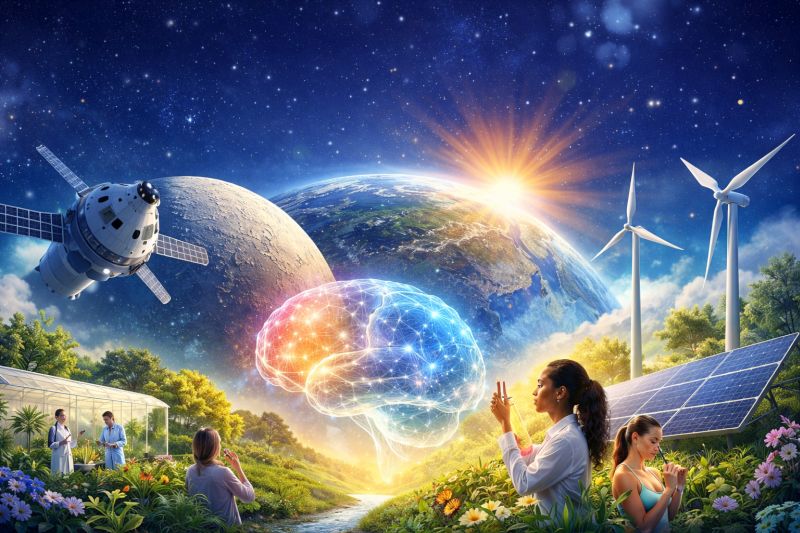


In 2025, science pushed forward despite uncertainty and pressure. Breakthroughs, debates, and human stories showed that progress is driven as much by persistence and people as by data and technology.
Even as public health systems faced setbacks, medical research continued to move forward. Driven by persistence and innovation, scientists uncovered insights that redefined disease prevention, reproductive health, and chronic illness — marking some of the year’s most consequential breakthroughs.
Health Discoveries That Redefined Medicine in 2025
Despite cuts to public health funding, 2025 saw major medical advances that reshaped understanding of disease and the human body. Highlights included 3D imaging of human embryo implantation, advances in male contraception, new gut microbiome insights, and safer antimicrobial technologies. Together, they signaled a shift toward more precise and inclusive care.
Women scientists were central to this progress. Marlena Fejzo’s discovery of genetic causes of severe pregnancy sickness brought overdue attention to women’s health, while female editors and journalists helped translate complex findings for the public.

Breakthrough Treatments for Drug-Resistant Tuberculosis
In 2025, an international trial identified three new all-oral treatments for drug-resistant tuberculosis, curing up to 90% of patients. Co-led by Professor Carole Mitnick, the regimens are shorter, safer, and effective for patients often excluded from trials, including children, pregnant women, and people with HIV. Quickly adopted by the WHO, the findings marked a major advance in equitable global health care.
The Strangest Scientific Discoveries of 2025 — And Why They Matter
Not all breakthroughs arrive neatly packaged — some of 2025’s most talked-about scientific moments were strange, unsettling, and quietly profound.
Scientists upended expectations in 2025. A carnivorous caterpillar that wears its prey’s bones challenged ideas about insect behavior. Evidence also hinted that Earth may lie within a vast cosmic void. Meanwhile, de-extinction advances—from mammoth-like mice to revived species—blurred the line between science fiction and reality.
Even the bizarre revealed practical insights. Hair-based toothpaste hinted at sustainable biomaterials, fungi-generated music expanded ideas of biological intelligence, and the discovery of a new color pushed the limits of human perception.
Together, these findings reminded us that curiosity-driven science — often led by diverse, interdisciplinary teams — is essential not only for progress, but for expanding how we understand what is possible.

Renewable Energy’s Breakthrough Year
In 2025, renewables hit a tipping point. Clean energy surpassed coal globally, with solar and wind alone covering all new electricity demand—earning Science magazine’s Breakthrough of the Year. Once driven by ideals, renewables are now winning on cost, speed, and scale.
China powered much of the surge, dominating production of solar panels, wind turbines, and batteries and exporting low-cost tech worldwide. As prices plunged and access spread, emissions growth slowed and a global carbon peak came into view. Despite hurdles, the message was clear: the energy transition isn’t coming—it’s already here.
An All-Seeing Eye on the Sky
Completed in 2025 atop Chile’s Cerro Pachón, the Vera C. Rubin Observatory ushers in a new era of astronomy. Instead of targeting single objects, it will scan the entire visible sky every three days for the next decade, capturing cosmic change at an unprecedented scale. In just one year, Rubin will gather more optical data than all previous telescopes combined, building an open, ultra-detailed 3D map of the universe.
Equipped with a 3,200-megapixel camera and a breakthrough optical system, the observatory will issue millions of alerts nightly—spotting asteroids, supernovae, and subtle clues to dark matter and dark energy. With smart algorithms sorting the flood of data, discovery will happen faster than ever before.
Read also: Underrated, Unwelcome, Unstoppable: Vera Rubin and the Discovery That Changed Everything

Record-Breaking Black Hole and Space Discoveries
In 2025 astronomers confirmed an exceptionally massive black hole merger and one of the oldest known black holes, expanding our understanding of how the early universe evolved.
Strange Metals Challenge Physics Models
Studies of “strange metals” in condensed-matter physics revealed unexpected electrical behavior that could pave the way toward understanding room temperature superconductivity — one of the biggest open problems in modern physics.
Science in 2025: Discovery, Debate, and the Human Story
Beyond headline-grabbing breakthroughs and technological milestones, 2025 was also a year in which science revealed its deeply human side. Research in 2025 reshaped our understanding of human origins, revealing that multiple ancient human species once shared the same landscapes. It also brought lost lives into focus, reconstructing the stories of the working poor buried beneath a 17th-century Italian hospital.
These stories reminded us that science is not only about progress. It is about recovering forgotten voices and expanding our collective memory.
At the same time, science confronted modern ethical and social tensions. Unconsented genetic data, experimental policing tools, and aid cuts exposed the fragile line between innovation and responsibility.
Many of these stories were shaped by women scientists and journalists. Their work showed how scientific decisions affect real lives, especially the most vulnerable.
The story of science in 2025 wasn’t a single discovery, but collective momentum. Driven by curiosity, debate, and collaboration, the year underscored a simple truth: scientific progress depends as much on people as on ideas.