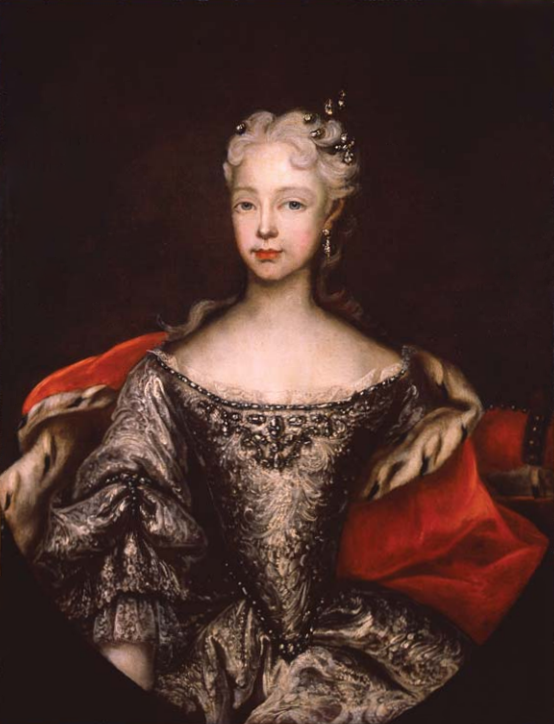

Sixteen children. Relentless wars. Political betrayal. And a 23-year-old Maria Theresa at the center of Europe’s most powerful dynasty.
History rarely gives women gentle beginnings. In 1740, when she inherited the Habsburg lands, courts across Europe did not see a sovereign — they saw an opportunity. Armies mobilized before the ink on her succession was dry. Rivals questioned her legitimacy. Allies hesitated.
So who was Maria Theresa?
Known to history as Maria Theresa of Austria, she became the only woman to rule the vast Habsburg dominions in her own right. She was not crowned Holy Roman Empress in her own name — that title legally belonged to a man — yet she governed as the true center of power. For forty years.
Europe underestimated her for one simple reason: she was young. And she was a woman.
She had not been rigorously prepared for rule. Her father had hoped for a son. Instead, the empire received a daughter — educated, intelligent, politically aware, but never intended to wear the crown. When the moment came, there was no transition period. No easing into leadership. Only crisis.
And yet, the narrative of Maria Theresa is not a sentimental tale of “doing it all.” She was not juggling board meetings and bedtime stories. She was reshaping a fragmented empire while giving birth to sixteen children. Sixteen.
Motherhood did not soften her authority. Power did not erase her domestic reality. Both existed — fully, unapologetically, and at scale.
By the time her reign ended in 1780, the young archduchess once dismissed by European monarchs had transformed into one of the most formidable rulers of the 18th century — a woman who did not inherit stability, but built it.

oil on canvas
Heeresgeschichtliches Museum, Vienna, Austria
German Source: https://commons.wikimedia.org/wiki/File:Charles_VI_(1685-1740),_Holy_Roman_Emperor.jpg
How Did Maria Theresa End Up on the Throne?
The Daughter No One Expected to Rule
She was born in 1717 in Vienna, the eldest daughter of Emperor Charles VI. At the time, her arrival was not seen as a political turning point. It was, quite simply, not the son the empire was waiting for.
For years, her father hoped for a male heir. Maria Theresa received an excellent education — languages, history, religion, diplomacy — but she was not systematically trained to govern. Europe, after all, was still convinced that power belonged to men.
And yet, politics has a way of rewriting expectations.
Her older brother had died in infancy. With no surviving sons, Charles VI issued the Pragmatic Sanction, a legal decree allowing a woman to inherit the Habsburg territories. It was a bold move — and one that required years of diplomatic negotiations across Europe. Many rulers signed agreements recognizing her future succession.
Many of them would later break those promises.
When Charles VI died in October 1740, 23-year-old Maria Theresa suddenly became Archduchess of Austria, Queen of Hungary, and ruler of a sprawling, complex monarchy. There was no coronation fairy tale moment. Instead, there were invading armies.
Prussia, Bavaria, France, and others saw weakness in her youth and in her gender. The War of the Austrian Succession erupted almost immediately. Territories were threatened. Alliances shifted. The empire she inherited was financially strained and militarily vulnerable.
But something unexpected happened.
In Hungary, facing resistance and war, Maria Theresa appeared before the Hungarian Diet holding her infant son. According to historical accounts, she appealed for loyalty and protection. The response was dramatic: the Hungarian nobles pledged their swords to their queen.
It was not theatrical fragility but political instinct.
From that moment, it became clear that Europe had miscalculated.

A Crown Under Fire: What Country Did Maria Theresa Rule?
When Maria Theresa inherited power in 1740, she did not step into a neatly bordered nation-state. She ruled a vast and fragmented collection of territories known collectively as the Habsburg Monarchy.
So, what country did Maria Theresa rule?
Austria formed the political core. But her authority extended far beyond Vienna. She was Queen of Hungary. Queen of Bohemia. Archduchess of Austria. Duchess of Parma, Tuscany, and other Italian territories. Her lands stretched across Central Europe — culturally diverse, administratively inconsistent, and politically delicate.
Where did Maria Theresa rule? Stretching across the Alps to parts of modern-day Italy, and from Prague to Pressburg (today’s Bratislava) and the Hungarian plains, her empire spanned much of Central Europe.
And she ruled it for forty years — from 1740 until her death in 1780.
But longevity did not mean calm.
Within months of her accession, Frederick II of Prussia seized Silesia, one of the wealthiest provinces in her realm. France and Bavaria joined the pressure. The War of the Austrian Succession became a continental conflict.
Many expected her to collapse under the strain. Instead, she reorganized.
She negotiated when necessary and fought when required. She compromised strategically — but never surrendered the core of her authority. Though she ultimately lost Silesia to Prussia, she preserved the monarchy itself. In a Europe eager to divide her inheritance, survival was already a victory.
Maria Theresa ruled until her final days, remaining deeply involved in state affairs even as her health declined. She died in 1780 at the age of 63, most likely from pneumonia. By then, the young ruler once dismissed by Europe had become the defining force of an empire that endured long beyond her lifetime.
What Did Maria Theresa Do to Strengthen the Habsburg Empire?
She did not rule passively. She rebuilt.
Faced with a fragmented and weakened monarchy, Maria Theresa focused on structure, not spectacle. She reformed the administration, centralized power, and introduced new tax systems — including taxes that reached the nobility, something previously almost unthinkable.
The army was reorganized. The economy was strengthened. Manufacturing and mining were actively supported, laying the groundwork for a more stable and modern state.
But one reform would outlive them all.
Read Also: Elizabeth Cady Stanton: The Woman Who Dared to Rewrite the Rules
Education for All — A Radical Idea in 1774
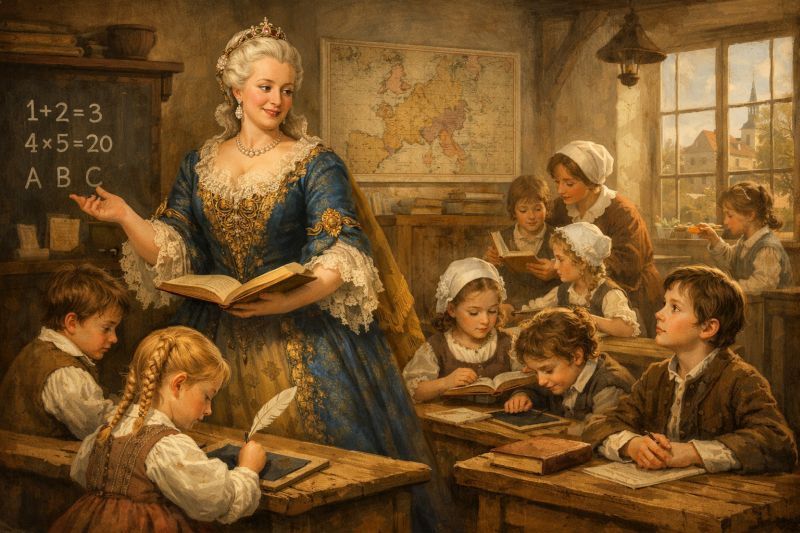
In 1774, Maria Theresa introduced the General School Ordinance — a decision that quietly reshaped Central Europe.
For the first time, education became accessible to all children, regardless of social status. Schools were to be established across the monarchy, and children were required to attend for six years.
Reading, writing, basic arithmetic. Simple skills — with enormous consequences.
Girls, who had long been excluded from formal education, were now included. Literacy began to spread. Opportunities slowly expanded.
It was not a symbolic reform. It was a structural one.
And centuries later, its impact is still visible.
And in the quiet shift from war rooms to classrooms, her legacy found its deepest roots. Not just in the borders she defended, but in the minds Maria Theresa helped shape for generations to come.